Monday, 21 January 2008

Back from vacation!

I just got back from a bit of an extended vacation. My boyfriend Mike arrived on December 27, having left Canada on Christmas day (but at 11pm, so he was still able to do all his traditional Christmas stuff!). So, soon after I returned from my Christmas celebrations at the lake, I was off to the airport to pick him up!

Mike was here for just under 3 weeks. We kept ourselves quite busy with some adventures in Malawi, a trip to Zanzibar, and a safari in South Luangwa National Park in Zambia.

We started off his time here by visiting a couple of different places in Malawi. Since I stay in Lilongwe, the capital, I wanted him to at least get a taste of a smaller town in Malawi, so we headed off to Dedza, a town just south of Lilongwe. It is known for its pottery (there is a large pottery workshop just outside of town) and the mountains and forests in the surrounding areas. We took a particularly uncomfortable minibus there, and, sure enough, it broke down en route. At least he was getting an authentic experience!
Photo 1: Our broken down minibus, somewhere between Lilongwe and Dedza.

We checked out the pottery place (and had some of the cheesecake it is apparently known for - quite yummy!), went walking around the rural areas and hiking up Dedza mountain, wandered around town and visited with a local family. Mike also got to sample some typical Malawian cuisine (some very tasty fish!).
Photo 2: Cute goat
Photo 3: Row of shops in Dedza

We continued on to Blantyre, where we spent a bit of time before flying to Zanzibar Island, just off the coast of Dar Es Salaam in Tanzania. We spent a week on the island, splitting our time between Stone town and by the beach on the north shore of the island.

We arrived in the evening and our first stop was Forodhani Gardens, where a long line of food stalls set up each evening. They serve such things as fish (including king fish, red snapper, barracuda, swordfish, etc) and meat kebabs, grilled seafood, samosas, chapattis, falafels, root vegetables, etc. You fill up a plate with what you want and they grill it for you. The prices are great and the food tasty! For refreshment, you can get a big mug of freshly (right before your eyes in fact) pressed sugarcane juice (spiced with some ginger) – delicious!
Photo 4: A table of food at Forodhani Gardens

Stone Town is a recently declared UNESCO World Heritage Site. It is quite an interesting place, blending Middle Eastern, Indian, Swahili and Moorish traditions and architecture. We spent days wandering around the narrow streets and busy markets, visiting the sites and doing a lot of eating!
Photo 5: Central market

Photo 6: Background – Anglican cathedral built over the site of a former slave auction floor, from the East African slave trade. Foreground – a “dala-dala,” which are converted lorries used as the main public transportation vehicles on the island

Photo 7: A beautiful door in Stone Town – many of the buildings have elaborately carved doors, adorned with brass studs

We spent New Years in Stone town with some friends of mine who visiting from Zambia. We had dinner at Forodhani Gardens, appetizers at a beautiful beachside restaurant, and drinks at a New Year’s Eve party on an ocean view patio – no champagne, but still a pretty fabulous way to celebrate!
Photo 8: Our table right on the beach (Ka-Hay, Thulasy, and Mike)

We then moved on to spend some time staying at a beach resort. We stayed in a beachfront bungalow on the North Shore of the Island. The beach was probably the most beautiful I’ve seen – beautiful fine white sand and a gorgeous blue sea. Just lovely.
Photo 9: Sitting on the beach
Photo 10: Beautiful sunset view from right outside of our bungalow

Photo 11: Mike and I on the beach

Mike got his scuba certification while there, so on our last day at the beach we went on a couple dives together. The diveshop used specially converted dhow sailing boats, made by local ship makers, to transport us to the dive sites, which was pretty neat!

After a magical time on Zanzibar island, wandering around Stone town, lounging on the beach, and eating amazingly well all the time, we had to make our way back to Malawi.

In an effort to save a bit of money, we decided to take a coach bus from Dar Es Salaam to Lilongwe. I know others that have made the journey, and it didn’t sound too bad. The trip was to take between 24 – 30 hours total.

Long story short, the trip was a bit disastrous. Due to breakdowns, border chaos, and other ridiculousness, it took many more hours than anticipated. If you're ever making this same trip, whatever you do, DON'T TAKE Mohamed Coach lines! In fact, at the Tanzania-Malawi border, we ended up jumping ship , and found alternative transportation to Lilongwe, getting ourselves there at minimum 12 hours before that god-awful coach bus would have arrived.
Photo 12: Coach bus from hell – it even looks a bit evil, doesn’t it?
Photo 13: We don't look too bad for having spent the past day and a half on a bus! (The view is of Lake Malawi in the Northern part of the country, when we had to get off the bus for it to manoeuvre around a tight curve because of a breakdown)

We had to quickly recover from our journey, as after a day of running around Lilongwe, we headed off on safari in Zambia. We went on a 4 day safari to South Luangwa National Park, which is widely regarded as one of the finest wildlife reserves in Africa. It was kind of nice to spend a few days where all details were taken care of for us, though we did encounter a couple hiccups right off the bat. First, Mike had to bribe a Zambian border official (who are generally known to be difficult and corrupt) because he lacked a yellow fever vaccination card – the Zambian official claimed it would have been fine if he was simply coming in from Malawi, but it was a problem since we were just in Tanzania (oddly enough, the health official when we were entering Malawi directly from Tanzania had no beef with him…). In any case, the bribe was much less than the vaccination would have been, so, it wasn’t the end of the world. Soon after this, our Land Cruiser broke down in the middle of nowhere after we passed through the border. That’s right, our 3rd breakdown in as many weeks. It took quite some time to get us going again, but we managed!

The safari itself was just great! Despite it being the rainy season, we didn’t get rained on once, and the game viewing was fantastic! We stayed in a lodge just outside of the park, right on the river where we could hear hippos grunting, and lots of baboons ran around the property. On the first night we had a hippo come strolling through the property, which was neat.

There were four of us on the safari and we went on 2 game drives a day for 2 days, one in the morning from 6-10:30 and one in the evening from 4 – 8 (a night drive for the second half). We drove around in a specially modified land cruiser, which was open at the back with 2 rows of seating.

I took a ridiculous number of photos, but here are a select few:
Photo 14: Giraffes, Impalas, and Zebra – oh my!
Photo 15: Hanging out with some giraffes during a tea break

Photo 16: Hippos messing around
Photo 17: 2 Lionesses and their cubs, lounging on the road

Photo 18: Elephants!
Photo 19: A hippo mum and baby emerging from the water during a night drive

Right after returning from the safari, Mike and I headed to the lake for a quick visit. We relaxed and ate some fantastic food, and it was a good wind down from the trip.

Now, Mike is back in Canada and I’m all by my lonesome again. It has been a bit of an adjustment settling back in my old routine again! It was wonderful having him visit me here. While we spend much of our time outside of Malawi, I think Mike still got a good glimpse into what my life here is like.

I now have to start trip planning for my next visitors – in a couple months my parents will be coming to Malawi to visit!

Thursday, 27 December 2007

My Malawian Christmas

I just finished celebrating my first tropical Christmas. It was definitely a big change from every previous Christmas I’ve experienced!

I was invited to spend Christmas this year with my housemates. I initially assumed that they would be spending Christmas with their parents and the rest of their family, so I had expected to be a part of some large family gathering at their parents’ home in a town near the Zambian border, an hour and a bit outside of Lilongwe. However, I soon found out this was not going to be the case. In fact, the plan was to spend Christmas at the lake with some friends.

In the afternoon of Christmas eve, my housemates Khala, Bon, and I got picked up by a minibus that was rented by Khala’s friend Isabel. The minibus was packed to the brim with people (a number of Isabel’s siblings and cousins were also joining us), lots of luggage and food, as well as extra mattresses and a braii.

We stayed at a place called the “Beach Villa” which was actually a complex of 20 or so “villas” (which make them sound fancier than they are . . . they were really just 2 bedroom cinderblock chalets) by the beach. There were 12 of us and we took up two of the chalets. We set up the braii (bbq) and so started a weekend filled with meat. It seemed like that braii was constantly loaded up with piles and piles of chicken, beef, or sausages. Not a vegetable or carb to be seen! I came prepared with a package of my trusty soya pieces so I made my own supper that first night.
Photo 1: Braii by one of our chalets

On Christmas eve evening we sat by the lodge eating, drinking, and listening to really loud music when someone informed us of a performance of gulewankulu (big dance). The Gulewankulu is an important traditional dance here, performed by “chilombo” or “moving spirits” who dress in masks and costume. No one has been able to give me a satisfactory answer as to what these moving spirits do exactly, but they are from the rural areas and dance at functions and celebrations, and otherwise just run around and cause mischief. If you’re not careful and especially if you disrespect them in some way, they may put a curse on you – so watch out! They also perform their dances for general spectators, such as what was happening by the lodge.

A large crowd gathered by the beach where the performance was taking place. The place we were staying at was filled with Malawians and I was the only Muzungu there, and in the crowd of spectators. The musical accompaniment was provided mostly by 5 or so drummers, who used wooden dug out drums with goat skin – they would frequently tune their instruments by placing the drum in the flames of a fire. The chilombo wore costumes ranging from a woman’s dress (though the dancer was more than likely a man), to coveralls, to big smocks covered in scraps of various fabrics. The masks ranged from being very plain to being huge and elaborate. The dancers went up one at a time (there must have been around 10 in total) and all had different styles, mostly depending on their costume - some were lots of hips, others lots of twirling and rolling around in the sand, and one danced with fire while another wore stilts. People in the crowd could go up and give the dancers money and then get them to do something for them. Typically they might want them to do some particular dance move, or dance with them, or have a photo taken. One little girl, who couldn’t be over the age of 7, went up and seriously busted a move in a dance off with one of them, and the crowd roared in approval. Someone I was with, without my knowing, gave one of them money to take a photo with me, so all of a sudden I had a crazy dressed dude come barreling towards me and pull me towards him for a photo op – I was slightly mauled but the crowd certainly l loved it!
Photo 2: Chilombo Dancer

Photo 3: The drummers

Once the show (which went on for at least a couple of hours) was done, we returned to the braii for yet more meat (I must admit to feeling a little left out!). All of a sudden we heard screams coming from nearby, followed by a herd of running children coming tearing past us. I went over to investigate the situation. Turns out, a black mamba snake (well, that's what I was told it was - they are quite poisonous apparently) had slithered into one of the chalets, in pursuit of a toad that had hopped inside. A group of men wielding pieces of PVC pipes came to take care of the situation. The snake was hiding under a bed so then men proceeded to jab it to near-death and then triumphantly came outside with the snake dangling at the end of the stick. The crowd shouted out instructions for them to chop its head off – the only proper way to do away with a poisonous snake apparently. So, they proceeded to chop the snake’s head off with a stick.
Photo 4: The snake being . . .um, done away with . . . (sorry for the slightly graphic image!)

The next day was filled with swimming and barbequing. I bought some fish (fisherman just wander around the beach and up into the lodges with bunches of fish tied with string for sale) so I got to participate in the festivities a little bit more which was nice!
Photo 5: Isabel, myself, and Khala on the beach

The dancers returned so we watched a few more performances – one of the dancers had a remarkably santa claus like mask on, the closest I came to seeing Santa on Christmas this year!
Photo 6: Dancer twirling
Photo 7: Santa?

In the afternoon we headed over to the nearby Livingstonia beach hotel campgrounds. We packed up the braii and set ourselves up right by the beach. It was quite a nice place, and absolutely hopping, filled with people. So, we spent the rest of Christmas swimming and eating. I received many phone calls from home, which was very nice!
Photo 8: Our prime location by the beach
Photo 9: Someone bought fish to bring back. You'll often see buses and cars around the lakeshore area with fish hanging outside - they do this because the airflow keeps the fish fresh apparently (plus I imagine that without a cooler, the fish would stink up the inside of a vehicle pretty quickly!)

Malawi is a predominantly Christian country, so Christmas is a widely celebrated holiday here. I’ve been doing a bit of an informal poll with people I’ve talked to over the past few weeks, trying to figure out what a typical urban Malawian does for Christmas. Most don’t seem to have any particular traditions – sometimes the lake, sometimes dinner with the family, and often nothing in particular.

My Christmas this year, while very enjoyable, definitely didn’t feel to Chrismasey to me! What with the bbqing, swimming, fireworks, etc it felt more like a Victoria Day or Canada long weekend to me!

People often asked me what Christmas was like back in Canada, so I told them about typical Christmas traditions. Upon hearing that people usually celebrate with a big dinner the typically reaction was to express disappointment with how dull our Christmases are! I would hardly call my usual Christmases boring, so I tried to elaborate on how fun things usually are, but still, the fact that the weather is cold and most things happen inside was enough for all Canadian Christmases to be deemed boring by the Malawians I was with. Oh well, I’m still very much looking forward to Christmas back at home next year!


Thursday, 20 December 2007

Seasons Greetings from Malawi!

It seems that the Christmas season is upon us. While my friends and family back in Canada are busy with parties, family gatherings, last minute shopping and tree trimming, I find myself feeling very far away from it all . . .

This will be my first Christmas away from home, and I won’t lie – I’m pretty bummed about it. Though, I keep having to remind myself that it is already late December and that Christmas is just around the corner –the usual signs signalling the arrival of the Christmas season for me aren’t here to nearly the same degree! There are few Christmas parties, no crowded shopping malls, no Christmas lights, no snow. It is probably the warm weather that throws me off the most! Some of the grocery stores are decked out in Christmas decorations, and the Shoprite has been playing Christmas carols since the beginning of November, but aside from that, it is distinctly unfestive here, compared to what I’m accustomed to!

To get myself into the Christmas spirit, I've decked out a small portion of my room with decorations - much to the amusement of my roommates!

Photo 1: Posing by my decorations

Photo 2: My room

As far as Christmas celebrations go, I believe I'll be spending a few days at the lake with my roommates. Festivities here are kept quite low key it seems, and my roommates aren't even going to be spending the holidays with the rest of their family (who are all within a couple of hours of us).

Spending Christmas day by the beach will be quite a dramatic change from my usual celebrations, which take place at the farm of some wonderful family friends (I'll miss you guys this year!!!!).

Photo 3: Christmas dinner at the Monkmans' place

In other news, my boyfriend is arriving in Malawi on December 27th, and we'll be doing some travelling around together, which will be very nice!

In case I’m unable to post for a little while, I wish you all the merriest of Christmases and the happiest of new years!

Friday, 7 December 2007

Some photos . . .

I can hardly believe that I’ve been here for over 4 months - here are some photos from the last couple of 'em!

Photo 1: Boys with mouse bashing sticks – this charming group of young men are wielding mouse bashing sticks. I’m not sure of the exact process, but somehow they entice mice to leave their holes and then bash ‘em to death (kind of like a real life whac-a-mole I guess!). Mice are eaten in some of the rural areas around here. One common way of preparing them is to dry them – mice are lined up and held between sticks and then dried over coals for a few hours. Once they’re done they’re eaten whole – fur, teeth, the whole bit!

Photo 2: Out in the field - I spend much of my time (30+%) doing field work, which typically involves doing surveys and assessing site conditions.

Photo 3: An unusual well - In the rural areas many communities are equipped with boreholes that have hand pumps to draw the water out. This well, however, was a little different . . . The water flows freely 24/7 from the pipe as it is an artesian well.

Photo 4: Dog in tobacco nursery – This cute little guy is relaxing in a tobacco nursery. Tobacco is a very important crop here, and it is raised in nurseries during the dry season before being transplanted in fields when the rains come.

Photo 5: Ladies in field - This photo was taken last week in the Southern Region of the country, where the rainy season has started. Farmers in this region have started cultivating their rain fed fields, such as can be seen in this photo where the fields are green with maize.

Photo 6: Cute kid with WFP cans – A very cute little kid hanging out with some World Food Program cans of oil now used as planters.

Photo 7: My new home - I moved into a new place little over a month ago. I’m now living with 2 roommates, a brother and sister . Various siblings and family members of theirs always seem to be passing through to stay here too. I am much much happier here than at my last place!

Photo 8: Hair salon in the living room - my roommate Khala getting her hair done by her friend Penelope from down the street. I feel like I have extremely boring hair here; ladies have their hair drastically changed ever few weeks. Meanwhile, I get my hair cut like once a year and keep it in a perma-ponytail. . .

Photo 9: Khala in doorway - my new roomie hanging out in our back doorway. After work almost every day we hang out on the back stoop eating popcorn enjoying the cool evening air.

Photo 10: Rickety bridges – The main market in town is divided in 2 by a river. If you want to get from one side to the other you have 2 options; you can walk a ways out of your way and take the main bridge, or, take a much more direct route across one of these private bridges. For the low low price of 7 cents (or 3.5 cents if the guy in charge is feeling generous) you can take a thrilling, death defying stroll across one of these rickety bridges!

Photo 11: Rickety bridge 2 – we made it safely across! During the rainy season (which is nearly upon us here in Lilongwe) these bridges get washed away, so the owners have to rebuild every year.

Photo 12: Bday at lake – I spent my 24th birthday with some friends at the lake.

Photo 13: Bday at the lake - brownies lit with birthday candles, decorations, balloons, and noisemakers, what more do you need for a complete birthday?

Monday, 3 December 2007

Let the rains begin!

It has been quite some time since I last posted . . . I have found myself to be quite busy lately – work has been hectic and I’ve been out of town a lot recently on field visits. A few other unexpected things have also come up, all of which have conspired to keep me from writing. So, I shall fix this situation with just a quick post today, and the promise of a more substantial one soon!

My most recently field trip had me visiting Blantyre district, in the south of Malawi. It seems that the rainy season has hit there in full force, adding a new, fun, and muddy dimension to field work!

The problems we encountered made me realize the challenges that the rainy season poses to conducting field work, and reminded me of one of the 6 biases that Robert Chambers (1983) describes as impeding outsiders’ contact with rural poverty, particularly the more extreme cases.
  1. Spatial biases: urban, tarmac and roadside (attention focused on communities with better roads leading from major cities
  2. Project bias: attention and funds beome ever more foccussed on increasingly atypical pet communities
  3. Person bias: views of a few key informants (the most articulate and therefore atypical) become recorded as representing the entire community
  4. Dry Season bias: visitors typically schedule visits during most clement weather; many of the more severe problems go unobserved
  5. Diplomatic biases: prevent real problems from being exposed and confronted
  6. Professional biases: specialization of interest resulting in tunnel vision, discourages an understanding of linkages
I find myself thinking about how these biases apply to the work that I do, and what steps we can take to minimize them as much as possible. As one example, we use random sampling techniques to select the sample of clubs we visit during our surveys, so we don’t choose villages based on ease of access, distance, etc. However, this becomes more difficult to stick to during the rainy season, when many routes become impassable…Indeed, getting heavily stuck in deep mud not once but twice in less than 18 hours, I could see that bias number 4 will undoubtedly play a role in the field work I participate in for the next few months, over the course of the rainy season period.

On our first afternoon of work, we started down one fine looking road before the field coordinator we were with informed us it had just been newly constructed. Normally it would be fine, but it rained for a couple hours earlier in the day . . . Before we knew it, the tires were bogged down with mud and we weren’t going anywhere in a hurry. The nice new road was a mess!

Photo 1: new road

We tried turning around and heading back the way we came, but ended up quickly sliding into a ditch, requiring the help of people from the neighbouring villages to get us out.

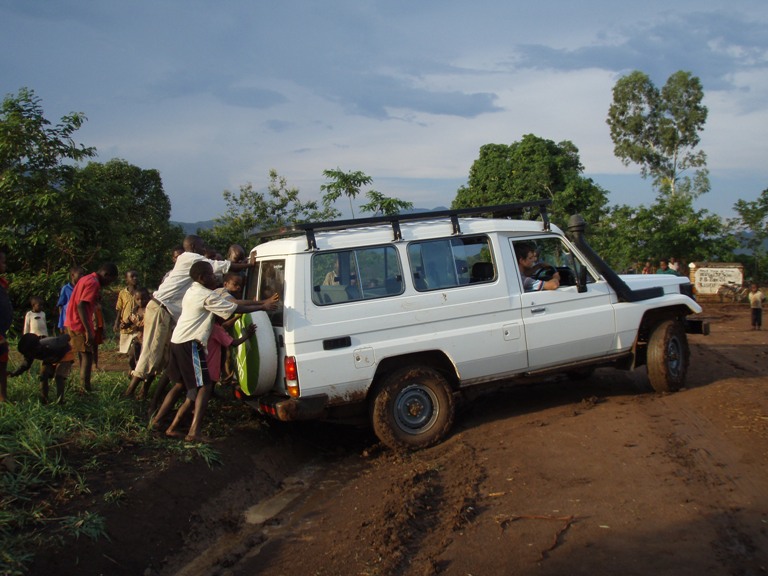
Photo 2: push!!!

We attracted quite the crowd!
Photo 3: Our crowd of onlookers

No sooner had we made it out of the ditch and we ended up in the ditch on the other side of the road . . .whoops!
Photo 4: ...and again!

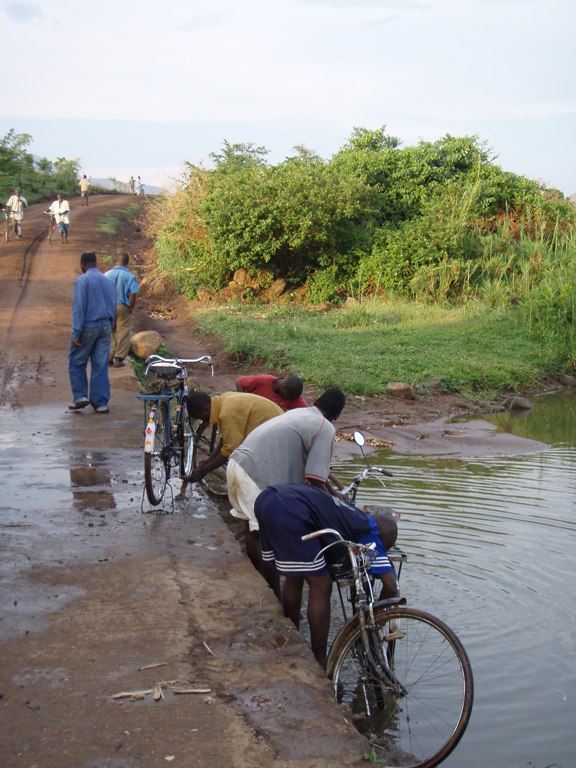
Back on a solid road, we managed to get to a few more sites . . . along the way we passed this group of gentlemen at a dam washing their bikes clean of mud.

Photo 5: bicyclists cleaning mud off their bikes

The very next day we set out bright and early in the hopes of a productive day! However, just as we rolled up to the first village we were to visit, rain came pouring down in sheets. Due to the nature of work we were there to conduct it wasn’t practical to head out in the rain. So, we sat in the vehicle, and waited it out. Nearly an hour passed with no end in sight, so we decided to revise our plans and return later in the day. We couldn’t go back the way we came because of flooding, so we were directed up a path we were assured was a much better road. . .

Photo 6: The awesome "much better" road, or so we were told

Sure enough, we got very stuck.

It was pouring rain out, and we had no one else around to help us out. We sat and waited for the rain to let up for a few hours – we needed help from people from the surrounding villages, but no one was out and about in the pouring rain! After a few failed attempts we were just about ready to give up and make the 10+km trek in the rain back to town on foot, with the hopes of somehow getting the vehicle out the next day, when a group of people showed up, ready to help!

I didn’t end up getting any photos which truly captured how ridiculously stuck we were, I was shocked that we actually got ourselves out – in involved the help of several farmers, and some creative use of rocks and planks to get ourselves out of a gully.

Photo 7: another audience!

Photo 8 : final shove!

We gave up on our workplan for the day, and returned to the village a couple days later to conduct our surveys.

Yes, I have little doubt that this whole rainy season thing is going to present some complications in the work we want to achieve…should be interesting!