Friday, 7 December 2007

Some photos . . .

I can hardly believe that I’ve been here for over 4 months - here are some photos from the last couple of 'em!

Photo 1: Boys with mouse bashing sticks – this charming group of young men are wielding mouse bashing sticks. I’m not sure of the exact process, but somehow they entice mice to leave their holes and then bash ‘em to death (kind of like a real life whac-a-mole I guess!). Mice are eaten in some of the rural areas around here. One common way of preparing them is to dry them – mice are lined up and held between sticks and then dried over coals for a few hours. Once they’re done they’re eaten whole – fur, teeth, the whole bit!

Photo 2: Out in the field - I spend much of my time (30+%) doing field work, which typically involves doing surveys and assessing site conditions.

Photo 3: An unusual well - In the rural areas many communities are equipped with boreholes that have hand pumps to draw the water out. This well, however, was a little different . . . The water flows freely 24/7 from the pipe as it is an artesian well.

Photo 4: Dog in tobacco nursery – This cute little guy is relaxing in a tobacco nursery. Tobacco is a very important crop here, and it is raised in nurseries during the dry season before being transplanted in fields when the rains come.

Photo 5: Ladies in field - This photo was taken last week in the Southern Region of the country, where the rainy season has started. Farmers in this region have started cultivating their rain fed fields, such as can be seen in this photo where the fields are green with maize.

Photo 6: Cute kid with WFP cans – A very cute little kid hanging out with some World Food Program cans of oil now used as planters.

Photo 7: My new home - I moved into a new place little over a month ago. I’m now living with 2 roommates, a brother and sister . Various siblings and family members of theirs always seem to be passing through to stay here too. I am much much happier here than at my last place!

Photo 8: Hair salon in the living room - my roommate Khala getting her hair done by her friend Penelope from down the street. I feel like I have extremely boring hair here; ladies have their hair drastically changed ever few weeks. Meanwhile, I get my hair cut like once a year and keep it in a perma-ponytail. . .

Photo 9: Khala in doorway - my new roomie hanging out in our back doorway. After work almost every day we hang out on the back stoop eating popcorn enjoying the cool evening air.

Photo 10: Rickety bridges – The main market in town is divided in 2 by a river. If you want to get from one side to the other you have 2 options; you can walk a ways out of your way and take the main bridge, or, take a much more direct route across one of these private bridges. For the low low price of 7 cents (or 3.5 cents if the guy in charge is feeling generous) you can take a thrilling, death defying stroll across one of these rickety bridges!

Photo 11: Rickety bridge 2 – we made it safely across! During the rainy season (which is nearly upon us here in Lilongwe) these bridges get washed away, so the owners have to rebuild every year.

Photo 12: Bday at lake – I spent my 24th birthday with some friends at the lake.

Photo 13: Bday at the lake - brownies lit with birthday candles, decorations, balloons, and noisemakers, what more do you need for a complete birthday?

Monday, 3 December 2007

Let the rains begin!

It has been quite some time since I last posted . . . I have found myself to be quite busy lately – work has been hectic and I’ve been out of town a lot recently on field visits. A few other unexpected things have also come up, all of which have conspired to keep me from writing. So, I shall fix this situation with just a quick post today, and the promise of a more substantial one soon!

My most recently field trip had me visiting Blantyre district, in the south of Malawi. It seems that the rainy season has hit there in full force, adding a new, fun, and muddy dimension to field work!

The problems we encountered made me realize the challenges that the rainy season poses to conducting field work, and reminded me of one of the 6 biases that Robert Chambers (1983) describes as impeding outsiders’ contact with rural poverty, particularly the more extreme cases.
  1. Spatial biases: urban, tarmac and roadside (attention focused on communities with better roads leading from major cities
  2. Project bias: attention and funds beome ever more foccussed on increasingly atypical pet communities
  3. Person bias: views of a few key informants (the most articulate and therefore atypical) become recorded as representing the entire community
  4. Dry Season bias: visitors typically schedule visits during most clement weather; many of the more severe problems go unobserved
  5. Diplomatic biases: prevent real problems from being exposed and confronted
  6. Professional biases: specialization of interest resulting in tunnel vision, discourages an understanding of linkages
I find myself thinking about how these biases apply to the work that I do, and what steps we can take to minimize them as much as possible. As one example, we use random sampling techniques to select the sample of clubs we visit during our surveys, so we don’t choose villages based on ease of access, distance, etc. However, this becomes more difficult to stick to during the rainy season, when many routes become impassable…Indeed, getting heavily stuck in deep mud not once but twice in less than 18 hours, I could see that bias number 4 will undoubtedly play a role in the field work I participate in for the next few months, over the course of the rainy season period.

On our first afternoon of work, we started down one fine looking road before the field coordinator we were with informed us it had just been newly constructed. Normally it would be fine, but it rained for a couple hours earlier in the day . . . Before we knew it, the tires were bogged down with mud and we weren’t going anywhere in a hurry. The nice new road was a mess!

Photo 1: new road

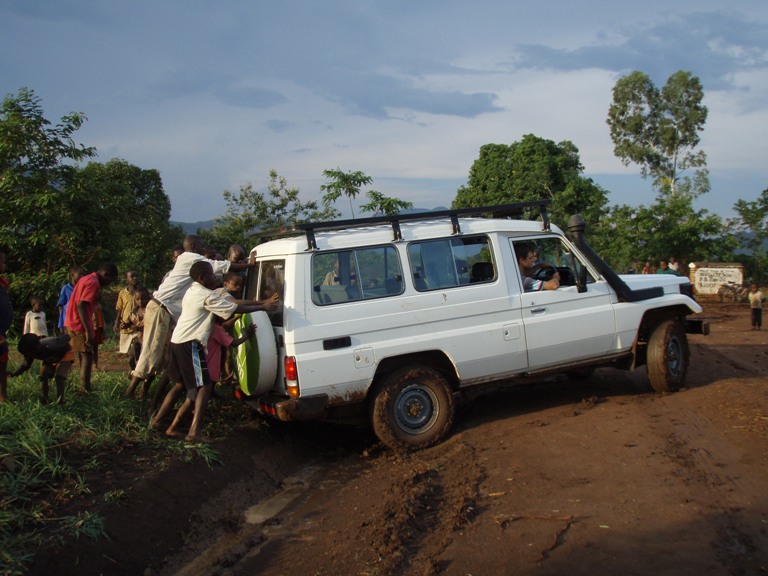
We tried turning around and heading back the way we came, but ended up quickly sliding into a ditch, requiring the help of people from the neighbouring villages to get us out.

Photo 2: push!!!

We attracted quite the crowd!
Photo 3: Our crowd of onlookers

No sooner had we made it out of the ditch and we ended up in the ditch on the other side of the road . . .whoops!
Photo 4: ...and again!

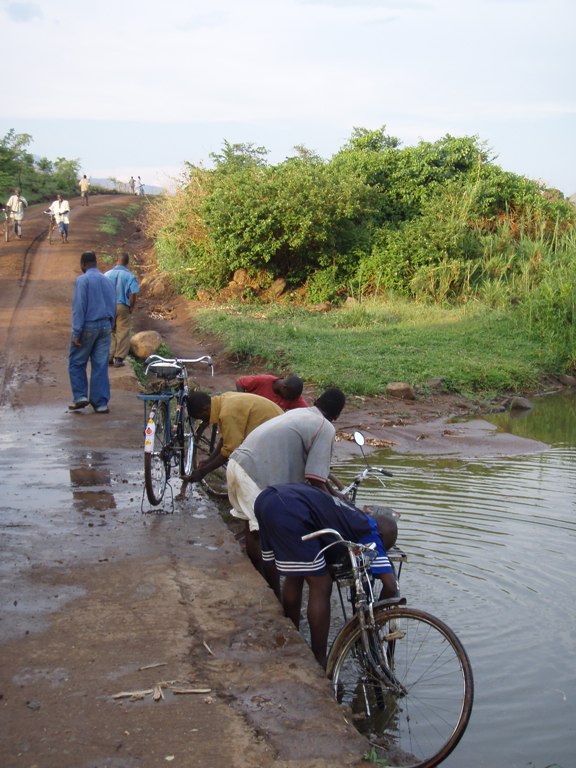
Back on a solid road, we managed to get to a few more sites . . . along the way we passed this group of gentlemen at a dam washing their bikes clean of mud.

Photo 5: bicyclists cleaning mud off their bikes

The very next day we set out bright and early in the hopes of a productive day! However, just as we rolled up to the first village we were to visit, rain came pouring down in sheets. Due to the nature of work we were there to conduct it wasn’t practical to head out in the rain. So, we sat in the vehicle, and waited it out. Nearly an hour passed with no end in sight, so we decided to revise our plans and return later in the day. We couldn’t go back the way we came because of flooding, so we were directed up a path we were assured was a much better road. . .

Photo 6: The awesome "much better" road, or so we were told

Sure enough, we got very stuck.

It was pouring rain out, and we had no one else around to help us out. We sat and waited for the rain to let up for a few hours – we needed help from people from the surrounding villages, but no one was out and about in the pouring rain! After a few failed attempts we were just about ready to give up and make the 10+km trek in the rain back to town on foot, with the hopes of somehow getting the vehicle out the next day, when a group of people showed up, ready to help!

I didn’t end up getting any photos which truly captured how ridiculously stuck we were, I was shocked that we actually got ourselves out – in involved the help of several farmers, and some creative use of rocks and planks to get ourselves out of a gully.

Photo 7: another audience!

Photo 8 : final shove!

We gave up on our workplan for the day, and returned to the village a couple days later to conduct our surveys.

Yes, I have little doubt that this whole rainy season thing is going to present some complications in the work we want to achieve…should be interesting!

Wednesday, 31 October 2007

A hectic week of moving, training, and retreating

I’ve had a bit of a hectic past week and a half.

It all started a couple weeks ago when things at home started going downhill in a hurry. People started acting strangely towards me, and one of the sisters started being downright mean. Long story short, I made the decision to move out at 10pm at night, and had moved out by 7am the next morning.

Part of the reason I moved out in such a hurry was the fact that I was soon going to be out of town for a week anyway with a couple of EWB related activities. In the evening of the day I moved out Thulasy and Nina, two of the girls I came to Southern Africa with. who are now based out of Zambia, were coming to Lilongwe. After I picked them up, we all got settled in to my old stomping grounds, St. Peter’s guest house.

Thulasy, Nina, Heather, and I – the 4 new EWB volunteers that arrived in Southern Africa in August – headed to Senga Bay on Sunday for our first quarter training. First quarter training is meant to be a time to allow us to reflect on our first few months of our placement, to develop a plan to focus the rest of our time on having maximum impact, to provide training on various professional development skills, and to give us time to relax, recharge, and have some fun together!

Our training was held at a lodge by the lake. It was quite a nice spot – a beach, a bar built over the lake, a nice restaurant, and tents with beds – what more could you possibly ask for?

Photo 1 – Most of our sessions were held in a pleasant covered area right by the beach.

Photo 2 – Ordering drinks at the bar from the lake . . . it took a few attempts (and some help from up above!)

Photo 3 – Group shot! Clockwise: Me, Thulasy, Levi (Director of Overseas sending – based out of Toronto but in Malawi and Zambia for a few weeks), Heather, Nina, and Dave.

After a few days of basking in the sun at the lake, we shipped out of Senga Bay, changing venues for our Quarterly retreat. Every few months the Southern Africa team, consisting of volunteers based out of Zambia and Malawi (there are 10 of us in total at present) get together for a long weekend of sharing, reflection, analysis, and good times. Some main goals of the retreat were to help transfer learning between volunteers, to create a future vision for EWB’s overseas work, and to build on knowledge of our sectors together as a team. Our days are spent in sessions on various things, but we did have one free afternoon for group fun times.

Our retreat was held at the Zomba plateau. Zomba was the capital of Malawi until the mid-1970s, and it is still a sizable, busy place. Overshadowing the town is the Zomba plateau. The Zomba plateau is divided into two halves by the Domasi Valley. The southern half has a road to the top, and is where we stayed at – get this – a trout farm, of all places!

The trout farm provided a surprisingly good venue; there were 3 lodges in which were exactly the number of beds we required. One of the lodges was essentially a log cabin and had a lovely view. It was bizarrely different from any place I’ve seen here so far – staying in the woods (with pine trees and all!) in a log cabin in 10 degree Celsius weather, we all felt like we were back in Canada!

Photo 4 – It was really quite chilly! Most of us spent the majority of the retreat wrapped up in blankets because we didn’t bring enough warm clothing! From Left to Right – Trevor, Thulasy, Levi (shirtless and basking in the African heat, of course, having just recently arrived from Canada), Danny, Me, Heather, Dave, Brett, Ka Hay, and Nina.

Photo 5 – It was quite damp while we were there, and for the first couple days there was an incredible amount of fog (and a bit of rain in the evening to go along with it!)

Photo 6 – A “cultural energizer.”

Photo 7 – I didn’t lie when I said we stayed at a trout farm! Here Nina and Heather – bundled up in blankets of course – are inspecting the trout farm ponds.

Photo 8 – Levi and Dave putting on a skit for us. Most of our sessions were held in that covered deck area in the background, which jutted out into a trout pond.

Photo 9 – Out on a morning walk we were happy to discover a big berry patch (though we later realized that berries could be found absolutely everywhere!). Strawberries, blackberries, and orange raspberries (my favourite!)– yum!

Photo 10 – Nina, Thulasy and I on the balcony of the main lodge

Photo 11 – On our first sunny day we decided to do a no-rain dance to keep the clouds away!

Photo 12 – On our free afternoon we went on a hike to a waterfall and to a lookout point. Much of the first part of our walk was done in the river – not the most efficient path possible, but it was fun!

Photo 13 – View from the top!

Sunday, 14 October 2007

What exactly am I doing at work anyway?

It is about time I give some details about what it is that I’m doing at work!
Photo 1: A Malawian farmer and myself after a survey

Background!
Before I arrived, Total Landcare (TLC) had a previous EWB overseas volunteer staff (OVS) member working with them. Her main role was to help TLC develop a Monitoring and Evaluation (M&E) system to better understand how they are having impact with their programs and how they can more effectively have impact in the future.

Photo 2: Surveying a smallholder farmer who is involved in one of TLC’s forestry programs

What is M&E all about?
Monitoring = Regular information gathering and frequent checking of short term progress with analysis
Evaluation = To judge the value or worth of something

The International Fund for Agricultural Development (IFAD) publication “A Guide for Project M&E” (2002) gives a great overview of project M&E in development projects.

M&E is used to learn about five main aspects of the project (IFAD, 2002):
1. Relevance
2. Effectiveness
3. Efficiency
4. Impact
5. Sustainability

Effective M&E can:
  • provide managers with information they need for day-to-day decisions;
  • provide key stakeholders with the information needed to guide the project strategy;
  • provide early warning of problematic activities and processes that need corrective action;
  • help empower primary stakeholders by creating opportunities for them to reflect critically on the project’s direction and help decide on improvements;
  • build understanding and capacity amongst those involved in the project;
  • motivate and stimulate learning amongst those committed to making the project a success; and,
  • assess progress so enable accountability requirements to be met (IFAD, 2002).
The data used in M&E this can be collected using a variety of methods including interviews, surveys, group discussions, transect walks, matrix scoring, and so on. Some involve individuals, some involve groups; some gather quantitative information, while others are gather qualitative information.

My Role!
The previous OVS helped improve the system of structures in place to deal with the flow of information between the field and the head office. These structures help to better capture lessons from the field and make sure that this knowledge is available to the decision makers at the head office.

My role now is to refine the system. I want to make sure it is sustainable and effective, and that the information gathered using it is being transformed into better decisions that lead to better and more sustainable impact.

Some of my basic goals are to help:
1) improve TLC's ability to collect, translate and deliver information;
2) internally allow TLC to monitor and evaluate their programming and impact so that they can maximize their future impact; and
3) improve internal communication.

In the past few weeks, my main tasks have been working on a set of standardized surveys to gather quantitative and qualitative information on all of our projects. This week I will be attending training on the use of Microsoft Access, after which I will construct a M&E database so we have a centralized system to store and access all of the data that has and will be gathered.
Photo 3: Checking out a forestry club’s tree seedling nursery

Photo 4: Surveying an irrigation farmer

My role here will evolve as time goes on, so I will provide updated details in the future!

Thursday, 11 October 2007

Lake of Stars Music Festival and Mother's Day

Lake of Stars Music Festival
While all my friends and family back in Canada were gathering together last weekend to eat turkey and pumpkin pies in celebration of Thanksgiving, I was at the Lake of Stars Music Festival.

The Lake of Stars Music Festival is an annual event (this was its 4th year) held at a lodge on the lake, approximately 4 hours north of Lilongwe.

I headed to the festival with Monica, the other EWB volunteer based out of Lilongwe, and two of her friends. We left on Friday afternoon, and arrived at sunset.

Initially we stayed at a nearby cottage, camping out in the yard. Getting to the festival required either a 45 minute walk along the beach, which could only be done during daylight hours because of a dangerous combination of rocks, hippos and crocodiles (when Monica and I did the walk during the day the only creatures we encountered was a herd of cattle being directed down the beach), or a short drive. The people we were with showed surprisingly low interest in spending much time at the festival, so Monica and I decided to jump ship and camp at the festival grounds instead. It was definitely the right decision!
Photo 1: Cows being herded along the beach

Photo 2: Festival main stage
Photo 3: Harry’s beach bar

The festival was a fun time. It was, however, a bit different than I anticipated. I felt like I was at a festival back in Canada – the set up, the acts, the food, the crowd – it all reeked of a European or North American festival. From what I gathered there, it seems that the entire planning committee was British. The level of Malawian musical content was also lower than I expected, which was disappointing. There were a few acts from Malawi, and a few from Southern Africa, but aside from them, the rest were flown in from the UK or the US. The demographics of the crowd seemed to suggest that every 20-something Muzungu (Westener) in all of Southern Africa was in attendance. There were a fair number of Malawians, but they were the minority. It is very unfortunate that the festival was so inaccessible to the average Malawian. The ticket cost alone was more than I pay for rent in a month.

Photo 4: Malawian fisherman in the foreground, with the tents of festival goers in the background.

Despite the guilt I felt about being an extravagant muzungu going away for the weekend to an expensive music festival, I had a good time! When not watching shows (there were some pretty fantastic acts there!), I spent much time lazing on the beach (a stone’s throw away from the 2 stages), chatting with people (Monica is a social butterfly and seemed to know pretty much everyone!), and eating the surprisingly good food. All in all, it was a very nice and welcomed break from my usual routine.

Photo 5: Lounging on the beach with a couple fellow Canadians and a Brit

Photo 6: Monica and myself
Mother's Day
I arrived back in Lilongwe on Monday, which was a National Holiday - Mother's Day.

Mother’s day at my household, however, had a bit of a sombre mood.

My host mother suffered a stroke early last week. At first, I didn’t even know that it happened. She spends most of her time in her room, so not seeing her up and about didn't seem unusual to me. I did, however, notice a distinct change in the moods of the sisters. It wasn’t until 2 days after it happened that my roommate told me.

She stayed at home to convalesce for a few days, but due to dangerously high blood pressure levels, she was hospitalized from Thursday until last night (Wednesday). My roommate, Gee, camped out at the hospital with her.

So, my house mum spent Mother’s day in a hospital bed. Her daughters prepared a big dinner at home and brought it to her to celebrate Mother’s day together as a family.

Everyone is back home now, and my host mum is recovering. She is paralysed on one side, and is going to be starting physiotherapy soon. I haven't seen much of her as she has been keeping to her room and I don't want to intrude. I feel like a bit of an extra burden at the moment, and am just trying to stay out of the way.

Wednesday, 3 October 2007

A weekend at the lake

Lake Malawi is kind of a big deal around here.

People are always asking me if I’ve made it up to the lake yet and raving about how nice a place it is to go for weekend getaways. So, I was thrilled when I was invited up to a cottage on the lake at Senga Bay (an hour and a half away from Lilongwe) last weekend.

Lake Malawi is the 3rd largest lake in Africa. The Lake dominates the geography of the country, following the contours of the Great Rift Valley for a distance of 585 km, reaching a width of 100 km at points. In all, it covers over 15% of the total land area Malawi.

Source: http://www.aquaria.info/graphics/misc/malawi.jpg

The shores are lined by sheer mountain cliffs and seemingly endless sandy beaches and the lake itself contains more freshwater fish species than are found in all of North America and Europe combined. Most of the fish are endemic to the lake.

Many of the cichlid species found in the lake are very popular in the aquarium trade. I hope to go scuba diving to check them out at some point while I’m here!

Source: http://www.vagabonding.com/photos/malawi/DSC01998_lake_malawi_fish.jpg

The majority of the animal protein in the Malawian diet comes from fish, and traditionally, Lake Malawi has supplied it by the boat load. However, wild populations have become increasingly threatened by over fishing and pollution. There was a lot of fishing going on near where I was staying, and I heard a few stories which reflected just how much smaller the catches have been in recent years.

Many of the photos I took at the lake came from a walk I took on Saturday afternoon. We passed bathing men in their briefs getting very sudsy (no photos of them though!), women laying out their freshly washed clothes and linens out to dry on the sand, and many men fixing their fishing boats (which ranged from dugout canoes to 25+ ft long wooden motor boats) and tending to their fishing nets.

Photo 1: View down the beach


Photo 2: Fabric left out to dry

Photo 3: Fishing boats

Photo 4: Fishing Nets

Photo 5: Solitary fishing boat

The cottage was a nice and relaxing time. In addition to hanging out on the beach, I spent much time monkey watching (lots of monkey mums with their babies!), climbed a hilltop for a gorgeous view of the surrounding bays, and watched as some car repairs happened on the car we broke as we drove in . . .

Photo 6: Fixing the car

Photo 7: Monkey mum and baby

Photo 8: View from the hillside.

It was really good to get out of the city for a little while. This upcoming weekend I will be making my return to the lake, but I'll be going to a place a few hours further north. I will be attending the Lake of Stars music festival, which features a wide array of Malawian and international acts. I haven't quite worked out how I'll get there, but I shall find a way . . . I hope!

Kim